
Night 2:The Microquasar Wakes Up
Separate the wheat from the chaff
Separate the wheat from the chaff
The data arrives and the first thing we do is analyse it.
The Theta Plot helps us see the number of gamma rays we detect in concentric rings at the point where we’re directing the telescope. But the analysis isn’t done yet. Actually, there are many other things that we need to do.
Something that is very important to do is to select, as far as possible, the images generated by gamma rays and those generated by other types of cosmic rays, such as protons or light nuclei.
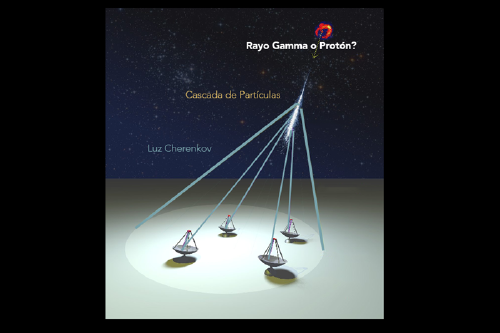
The Cherenkov light detected by the MAGIC telescopes. So, how do we know if what we detect is a gamma ray or a proton? Image Credit: Heinrich J. Voelk, Konrad Bernloehr
Actually, we don’t know for sure if what we detect is a gamma ray or another particle. We have developed a software that gives each detection a value that represents how much it looks like a gamma ray or something else (proton, muon, nucleus of a light atom, etc. ). It’s what we call hadroness.
The hadroness is a number between 0 and 1. A low hadroness means that what we have detected is likely to be a gamma ray. A high hadroness means that it's most likely a different type of cosmic ray.

When creating the theta plot, we need to make sure that we’re representing the events with small hadroness, since we’re hunters of gamma rays, right? So, we get rid of the protons.
I have a confession to make: the data that we used when detecting the CasA gamma rays on my night already had the hadroness cut done. I didn't tell you before because I didn't want to stress you out but we'd actually already separated the wheat from the chaff.

Now, have a look at my notebook on the right to see how by doing a cut in hadroness we get to see signal … or not?
Have you seen theta plot? With that, I would write the paper while thinking about how lucky I am to have hunted Cyg-X1. But every time I get excited, I remember what my thesis supervisor always tells me:
This is experimental physics, Alba. We need data, a lot of data, to prove something.
-How do you know that what you’re looking at isn’t noise?
-How do you know for sure it’s really Cyg-X1, and not just because you’re dying to have got something?
-Don’t get too excited and hold on for more data to arrive so that you can analyse them.
import pandas as pd
import matplotlib.pyplot as pl
from Theta2ConCorteHadronness import *
%matplotlib inline
Looking for signal in Cyg-X1
Here, we have the data from Cyg-X1 … let’s see how we look for a signal in them
The first thing is to read the data we’ve got. I see that Daniel used a function that he created without explaining too much about what it really does … that’s fine to start with, but maybe now it’s time to see what’s inside the function: When Daniel does leer(“luna”), what he actually does is:
luna=pd.read_csv(“EmisionLuna.txt”, , sep=’ ‘)
And with this, he creates a variable luna that contains all the information that’s already in the file “EmisionLuna.txt”.

There are 3 columns and several rows. Here, we can only see the first 5. If we want to use the data on the longitud de onda (wavelenght in Spanish), we can find them here:
luna.LongituOnda
If we want the data from the Emision (emission), they’re here:
luna.Emision
The first column is an index, like the one in an Excel, for example.
To see the first 5 rows of the file we can do:
luna.head(5)
To see how many rows there are in the data we can do:
len(luna)
Now it’s time to do it with my CygX1 data. First, let’s read the files that contain the events for ON and OFF (assuming you remember what ON and OFF are… you do remember, right?)
#We read the files and give them a name
cygX1_ON= pd.read_csv('data/EvtList_ON_CygX3_1day.txt', sep=' ')
cygX1_OFF= pd.read_csv('data/EvtList_OFF_CygX3_1day.txt', sep=' ')
Now that I know what the values of theta square for my ON and OFF data are, I can find them using this:
cygX1_ON.theta2 cygX1_OFF.theta2
# We look at what the first 5 values of theta2 of the ON look like, for example
cygX1_ON
cygX1_ON.theta2.head(5)
0    0.149
1    0.178
2    0.011
3    0.020
4    0.317
Name: theta2, dtype: float64
# And also, how many rows the file has
len(cygX1_ON)
32654
There are more than 30 thousand events detected by the telescope. That’s insane! Plus, looking at the data like that does not help much. What we’re going to have to do is represent them graphically.
Now that I think about it, Daniel hasn’t shown you how to create the famous Theta Plot! Next time I see him, I’ll be having words with him!
Never mind. Let’s get on with it ourselves. Instead of doing the simple ** histogram (“home”, “off”) ** you have to follow a few more steps:
- Define the size and colours of the space where we will draw the graph
- Generate the bar graph for ON (** cygX1_ON.theta2 ) and OFF ( cygX1_OFF.theta2 **)
- Name the axes
- Draw the graph
Let’s see how it’s done:
# 1 Define figure space
pl.figure(1, figsize=(10, 5), facecolor='w', edgecolor='k')
# 2 Bar graph ... cygX1_OFF.theta2 and cygX1_ON.theta2 is where I have the values
# that you have to represent. The rest is just cosmetic graphics, don't worry about that
# too much for now
pl.hist(cygX1_OFF.theta2, bins=30, histtype='stepfilled',alpha=0.5, color='red', normed=False)
pl.hist(cygX1_ON.theta2, bins=30, histtype='step',alpha=0.9, color = 'blue', normed=False)
# 3 Name the axes
pl.xlabel('$\Theta^2$ [$grados^2$]')
pl.ylabel('Numero de Eventos')
# 4 Draw the graph ...
pl.show()

There’s nothing here … it seems that Daniel has not only done one over on you with the code but with the analysis as well!
One of the biggest problems of being a gamma ray hunters is that, in addition to the gamma rays, we also capture nuclei of atoms (mainly protons). So, to see something that make sense, we need to get rid of these other rays.
Check out what the Theta Plot looks like when I take away the protons:
from Theta2ConCorteHadronness import *
Non, Noff = histograma_hadronness(0.20)

Now I’m the one who’s cheating and not telling you how I ended up with events with small hadroness, :D.
But, you can’t tell me that the graph isn’t pretty. You can see that there are far fewer events than before and that … WE’VE GOT A SIGNAL !!!
Let’s see what significance this signal has:
from Significancia import *
CalcularSignificancia(Non, Noff)
2.6845929556404116
Not bad, 2.7 sigma for a cut of 0.20. But what does this mean? Follow me for a while and I’ll try to explain it to you.
Dictionary of the gamma ray hunter
Active Galactic Nuclei
There's party going on inside!
This type of galaxy (known as AGN) has a compact central core that generates much more radiation than usual. It is believed that this emission is due to the accretion of matter in a supermassive black hole located in the centre. They are the most luminous persistent sources known in the Universe.
Find out more:

Black Hole
We love everything unknown. And a black hole keeps many secrets.
A black hole is a supermassive astronomical object that shows huge gravitational effects so that nothing (neither particles nor electromagnetic radiation) can overcome its event horizon. That is, nothing can escape from within.

Blazar
No, it's not a 'blazer', we aren't going shopping
A blazar is a particular type of active galactic nucleus, characterised by the fact that its jet points directly towards the Earth. In other words, it’s a very compact energy source associated with a black hole in the centre of a galaxy that’s pointing at us.

Cherenkov Radiation
It may sound like the name of a ames Bond villain, but this phenomenon is actually our maximum object of study
Cherenkov radiation is the electromagnetic radiation emitted when a charged particle passes through a dielectric medium at a speed greater than the phase velocity of light in that medium. When a very energetic gamma photon or cosmic ray interacts with the Earth’s atmosphere, a high-speed cascade of particles is produced. The Cherenkov radiation of these charged particles is used to determine the origin and intensity of cosmic or gamma rays.
Find out more:

Cherenkov Telescopes
Our favourite toys!
Cherenkov telescopes are high-energy gamma photon detectors located on the Earth’s surface. They have a mirror to gather light and focus it towards the camera. They detect light produced by the Cherenkov effect from blue to ultraviolet on the electromagnetic spectrum. The images taken by the camera allow us to identify if the particular particle in the atmosphere is a gamma ray and at the same time determine its direction and energy. The MAGIC telescopes at Roque de Los Muchachos (La Palma) are an example.
Find out more:

Cosmic Rays
You need to know how to distinguish between rays, particles and sparks!
Cosmic rays are examples of high-energy radiation composed mainly of highly energetic protons and atomic nuclei. They travel almost at the speed of light and when they hit the Earth’s atmosphere, they produce cascades of particles. These particles generate Cherenkov radiation and some can even reach the surface of the Earth. However, when cosmic rays reach the Earth, it is impossible to know their origin, because their trajectory has changed. This is due to the fact that they have travelled through magnetic fields which force them to change their initial direction.
Find out more:
Dark Matter
What can it be?
How can we define something that is unknown? We know of its existence because we detect it indirectly thanks to the gravitational effects it causes in visible matter, but we can’t study it directly. This is because it doesn’t interact with the electromagnetic force so we don’t know what it is composed of. Here, we are talking about something that represents 25% of everything known! So, it’s better not to discount it, but rather try to shed light on what it is …
Find out more:

Duality Particle Wave
But, what is it?
A duality particle wave is a quantum phenomenon in which particles take on the characteristics of a wave, and vice versa, on certain occasions. Things that we would expect to always act like a wave (for example, light) sometimes behave like a particle. This concept was introduced by Louis-Victor de Broglie and has been experimentally demonstrated.
Find out more:

Event
These really are the events of the year
When we talk about events in this field, we refer to each of the detections we make via telescopes. For each of them, we have information such as the position in the sky, the intensity, and so on. This information allows us to classify them. We are interested in having many events so that we can carry out statistical analysis a posteriori and draw conclusions.

Gamma Ray
Yes, we can!
Gamma rays are extreme-frequency electromagnetic ionizing radiation (above 10 exahertz). They are the most energetic range on the electromagnetic spectrum. The direction from which they reach the Earth indicates where they originate from.
Find out more:
Lorentz Covariance
The privileges of certain equations.
Certain physical equations have this property, by which they don’t change shape when certain coordinates changes are given. The special theory of relativity requires that the laws of physics take the same form in any inertial reference system. That is, if we have two observers whose coordinates can be related by a Lorentz transformation, any equation with covariant magnitudes will be written the same in both cases.
Find out more:

Microquasar
Below you will learn what a quasar is...well a microquasar is the same, but smaller!
A microquasar is a binary star system that produces high-energy electromagnetic radiation. Its characteristics are similar to those of quasars, but on a smaller scale. Microquasars produce strong and variable radio emissions often in the form of jets and have an accretion disk surrounding a compact object (e.g. a black hole or neutron star) that’s very bright in the range of X-rays.
Find out more:

Nebula
What shape do the clouds have?
Nebulae are regions of the interstellar medium composed basically of gases and some chemical elements in the form of cosmic dust. Many stars are born within them due to condensation and accumulation of matter. Sometimes, it’s just the remains of extinct stars.
Find out more:

Particle Shower
The Niagara Falls of particles!
A particle shower results from the interaction between high-energy particles and a dense medium, for example, the Earth’s atmosphere. In turn, each of these secondary particles produced creates a cascade of its own, so that they end up producing a large number of low-energy particles.

Pulsar
Now you see me, now you don't
The word ‘pulsar’ comes from the shortening of pulsating star and it is precisely this, a star from which we get a discontinuous signal. More formally speaking, it’s a neutron star that emits electromagnetic radiation while it’s spinning. The emissions are due to the strong magnetic field they have and the pulse is related to the rotation period of the object and the orientation relative to the Earth. One of the best known and studied is the pulsar of the Crab Nebula, which, by the way, is very beautiful.
Find out more:

Quantum Gravity
A union of 'grave' importance ...
This field of physics aims to unite the quantum field theory, which applies the principles of quantum mechanics to classical systems of continuous fields, and general relativity. We want to define a unified mathematical basis with which all the forces of nature can be described, the Unified Field Theory.
Find out more:

Quasar
A 'quasi' star
Quasars are the furthest and most energetic members of a class of objects called active core galaxies. The name, quasar, comes from ‘quasi-stellar’ or ‘almost stars’. This is because, when they were discovered, using optical instruments, it was very difficult to distinguish them from the stars. However, their emission spectrum was clearly unique. They have usually been formed by the collision of galaxies whose central black holes have merged to form a supermassive black hole or a binary system of black holes.
Find out more:

Supernova Remnant
A candy floss in the cosmos
When a star explodes (supernova) a nebula structure is created around it, formed by the material ejected from the explosion along with interstellar material.
Find out more:

Theory of relativity
In this life, everything is relative...or not!
Albert Einstein was the genius who, with his theories of special and general realtivity, took Newtonian mechanics and made it compatible with electromagnetism. The first theory is applicable to the movement of bodies in the absence of gravitational forces and in the second theory, Newtonian gravity is replaced with more complex formulas. However, for weak fields and small velocities it coincides numerically with classical theory.
Find out more: